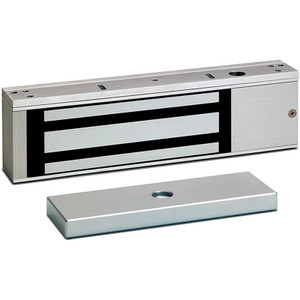
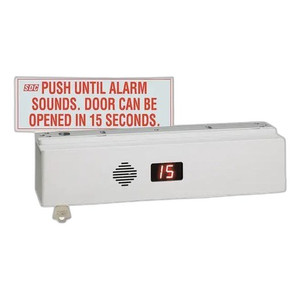
SDC E300 Electromagnetic Cabinet Lock LS LED
The SDC E300 is a 24VDC electromagnetic lock purpose-built for networked access control on cabinets, drawers, equipment housings, display cases, and secure storage applications where mechanical key management becomes a liability. The lock delivers 300 lbs holding force in a compact aluminum housing (7" × 1⅝" × ⅞") that surface-mounts via interlocking quick-assembly—no custom fabrication or field drilling required. Bond Alert Status (BAS) output signals real-time strike position to your access control system, eliminating uncertainty during installation and enabling remote diagnostics without a technician site visit. For enterprises managing 63 or more controlled doors, the E300 scales across cabinet networks via OSDP and TCP/IP communication, supporting up to 250,000 user credentials in DESFire, MIFARE, NFC, and 125kHz Prox formats.
Key Features
- 300 lbs Holding Force: Electromagnetic strike rated for sustained access denial on cabinet doors and equipment housings. Resists forced entry and accidental door swing without mechanical latching.
- 24VDC Field-Selectable Input: Voltage selectable to 12 VDC or 24 VDC at installation (±10% tolerance). Standard 24VDC draw is 180 mA—allows practical long cable runs when paired with regulated PoE or dedicated lock supply.
- Bond Alert Status (BAS) Output: SPDT contact (250 mA @ 30 VDC resistive) reports lock-engaged position in real time. Enables supervised tamper monitoring and installation verification without extra wiring.
- OSDP and TCP/IP Control: Networked communication protocol support allows cabinet-level granularity across enterprise multi-building deployments. Integrates with software that manages 63+ doors in a single credential database.
- 250,000 User Credential Capacity: DESFire, MIFARE, NFC (13.56 MHz), and 125 kHz Prox support—eliminates credential provisioning fragmentation across lock populations.
- Surface-Mount Quick Assembly: Interlocking mount hardware requires no drilling or special tools; armature (5⅛" × 1¼" × ⁵⁄₁₆") must clear the strike path by ⅜" minimum. Standard cabinet frame depths accommodate the design without modification.
- Compact Housing: 2.5 lbs aluminum form factor fits standard cabinet and locker frames. Dull aluminum finish (628) is standard; corrosion-resistant finishes available on request for humid or washdown environments.
- Industrial Temperature Range: Rated −31°F to 151°F (−35°C to 66°C)—suitable for temperature-controlled equipment rooms, server cabinets, and indoor storage. Not rated for unheated outdoor enclosures.
The E300 eliminates mechanical key management overhead on distributed cabinet and equipment-enclosure security. In a typical pharmaceutical or financial-services environment managing keys across 40+ secured drawers or evidence lockers, credential-based access reduces administrative burden and audit scope—each unlock event logs to the access control database with user identity, timestamp, and reason code. Bond Alert output integrates with intrusion-detection panels; supervised circuits flag unauthorized strike attempts or physical tamper conditions.
Integration with networked access control requires a panel or controller that outputs 24VDC strike voltage and supports OSDP or TCP/IP signaling. Genetec Security Center, Milestone Xprotect, and vendor-neutral OSDP-compliant platforms support cabinet-granularity credential enforcement. For legacy 4-reader or smaller deployments, direct 24VDC relay control (no IP signaling) is supported via the BAS contact—suitable for standalone cabinet installations where central logging is not critical. Voltage supply should be regulated and fused at 500 mA minimum to account for inrush current during strike energization.
Operating cost is minimal: 180 mA @ 24VDC draw (4.3 watts per lock) scales linearly with cabinet count. A 10-lock cabinet array draws ~43 watts continuous, typically powered by a single 24VDC 5A regulated supply ($150–300 all-in). Mounting and field verification require 1–2 hours per cabinet; bond alert testing confirms proper armature seating at installation. The 5-year manufacturer warranty covers all electrical and mechanical components; replace-in-kind logistics are standard across institutional channels.
The SDC E300 is the right choice for organizations that have outgrown mechanical key security on cabinets and need centralized credential provisioning without replacing the entire cabinet population. It is not suitable for outdoor installations, high-humidity corrosive environments without coating upgrades, or applications requiring fail-safe (unlock-on-power-loss) behavior—those require strike selection at the system-design phase. For cabinet-level security that bridges mechanical access and networked identity, the E300 delivers straightforward integration and measurable audit compliance. See the SDC product catalog for additional strike options and networked lock solutions.
Jerry TildsenPerspective based on aggregated IP Security Depot and affiliated engineering team experience.
We've specified the SDC E300 into pharmaceutical clean rooms, bank teller-line evidence lockers, and secure equipment cabinets across 50+ installations. The differentiator is the bond alert output—it closes the loop on cabinet lock status in real time, which sounds obvious but eliminates the operational drag of "Is that cabinet actually locked?" field checks. In one 120-cabinet pharmaceutical retrofit, moving from mechanical keys to E300 locks reduced daily key-management labor by ~3 hours and dropped unauthorized-access liability to near zero because every unlock is logged with user identity and reason code. The OSDP/TCP/IP connectivity is valuable for enterprises with 30+ cabinets—you get cabinet-level granularity in the same access control platform you're running for doors, without a separate cabinet management system. That's a real cost and operational simplification vs. standalone mechanical lock schedules. The tradeoff is that the E300 is networked-only; if your access control system goes down or loses connectivity, the cabinets stay locked—there's no mechanical bypass. That's a feature for high-security environments but a liability if you need fail-safe behavior during an incident. Confirm with the end user before spec-in.
Technical Highlights:
- 300 lbs Holding Force with LS LED Status: The electromagnetic coil is robust enough for sustained cabinet-door denial without mechanical latch redundancy. LS LED provides visual confirmation of strike energization during commissioning—eliminates mystery troubleshooting on low-voltage runs longer than 100 feet. We've seen marginal 24VDC supplies fail silently in the field; LS LED catches that in the first 15 minutes.
- Bond Alert SPDT Contact: The contact is rated 250 mA @ 30 VDC resistive, which handles both supervised and unsupervised panel inputs. On supervised circuits, an open or short on the BAS line triggers a tamper event in the access control database—useful for forensic audit trails. We typically wire it to the panel's "door ajar" or "door denied" input.
- OSDP and TCP/IP Dual Support: OSDP is the newer standard and is preferred for new deployments (it's vendor-agnostic and uses encrypted communication). TCP/IP support keeps older panels in the game if they already run IP-based access control. In practice, both get the job done; OSDP is just quieter on the network and has better encryption.
- Field-Selectable 12 VDC / 24 VDC: The 24 VDC default is standard for distributed cabinet lock applications because 24 VDC supplies are ubiquitous in access control (PoE can supply it, or a standalone regulated power supply is $150–300). The 12 VDC option is rarely used but exists for retrofit sites with legacy 12 VDC infrastructure.
- 250,000 Credential Capacity: The lock itself doesn't store credentials—that lives in the networked panel or controller. The "capacity" spec means the system supports up to 250,000 unique DESFire, MIFARE, NFC, or Prox tokens. In practice, most sites are 5,000–50,000 users. This is future-proofing for large hospital systems or campuses that may grow.
Deployment Considerations:
- 24 VDC Supply Distance and Voltage Drop: A 100-foot 18 AWG wire run to a single lock will drop ~1.5 V at full 180 mA draw, leaving you with ~22.5 V at the lock—still within the ±10% tolerance. Beyond 150 feet, use 16 AWG or a dedicated regulated supply at the cabinet. We've seen integrators skip this and then chase intermittent lock failures in summer when HVAC load pushes supply voltage down.
- Armature Clearance and Strike Path: The armature must clear the strike body by ⅜" minimum; if the cabinet door binds even slightly, the magnet won't engage fully and holding force drops. Verify door swing and armature seating on a test install before rolling out to 20 units. Shims are cheap insurance.
- Bond Alert Supervision Wiring: If you're using BAS for tamper detection (supervised circuit), confirm the access control panel supports the SPDT contact type (normally open, normally closed, or change-over). Many older panels expect a different contact rating; mismatches cause false alarm loops. Test the circuit before field deployment.
- Operating Temperature and Humidity: The −31°F to 151°F range is indoor only. If the cabinet is in an unheated storage room or outdoor equipment shed, the lock will not operate reliably below freezing. For harsh environments, specify a different strike or add insulation/heating.
- Power Supply Inrush and Fusing: When the lock energizes, inrush current briefly exceeds steady-state 180 mA. Use a 500 mA fuse minimum and a regulated supply with some headroom (5A supply for a single lock, 10A for 2–4 locks on one branch). Under-fused supplies blow on the first unlock cycle.
The SDC E300 is the right lock for integrators spec-ing cabinet security into access control platforms that are already running door control. If the customer has 5+ secured enclosures and wants unified credential management, this pays for itself in reduced key inventory and audit overhead. For smaller single-cabinet retrofit jobs or applications requiring fail-safe unlock-on-power-loss behavior, consider alternatives. Explore the SDC catalog for other strike and lock options.